
Collection 3 (December 2025): Finding our feet (the shock of the new)
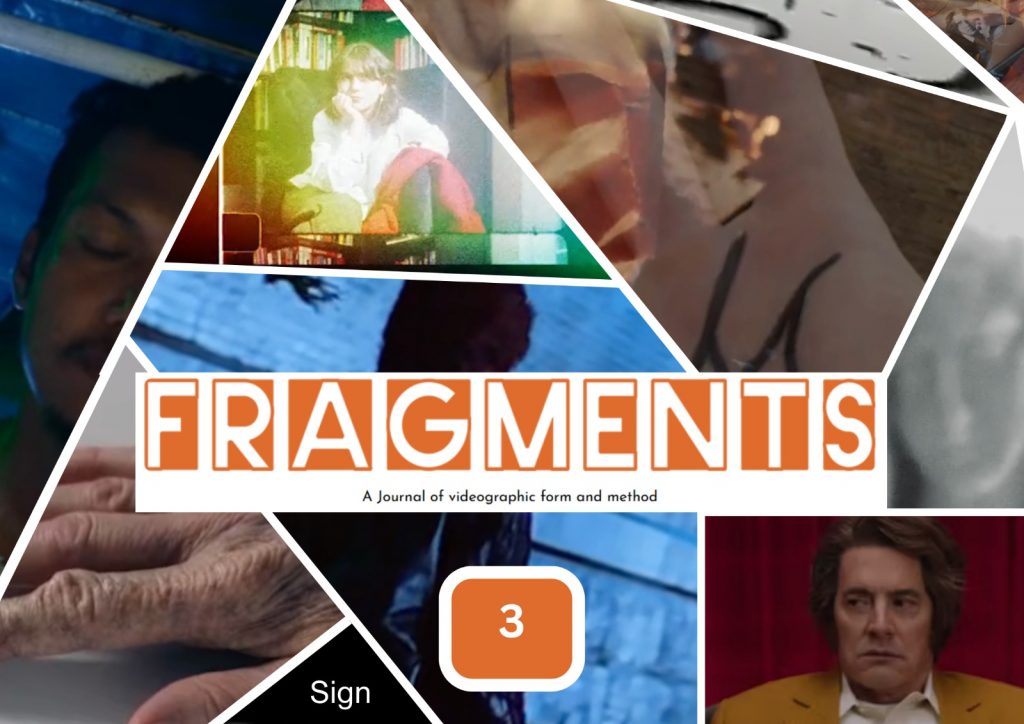
Our Definitions
- ‘Fragment’ – what you submit for inclusion in the journal via our online submission form
- ‘Collection’ – a monthly editorial gathering and reflecting on the Fragments submitted.
We are very pleased to present our third collection of fragments and once again thank all our contributors for taking the time to submit to the journal. The positive response from the videographic community (and beyond) has been extremely gratifying and we are glad our site seems to be finding a niche in the publishing arena, and making space for what may otherwise be unseen videographic works.
And on the point of our niche, we also feel that (perhaps?) we are getting to grips with just what this journal (and database) might become. Every submission we have received has posed a question to us about our intent for Fragments, and indeed the implementation of our manifesto pledge. What we have come to realise over the course of these three editorials is that our initial conception of what a ‘fragment’ might be was perhaps a little narrow, but also that our manifesto must continue to be our guiding star in respect of the development of the journal as a site for experimentation, play, and the messiness of making. In the face of ‘the shock of the new’* (this being, for all of us, our first foray into running a journal) we are finding our feet, and feeling our way through this process. Indeed, perhaps these early editorials are in some ways reflections of the videographic fragments we’ve received; sometimes indecisive and ‘imperfect’, yet continually embracing new possibilities.
We look forward to receiving more of your fragments and expanding our engagement with you in 2026.
*‘The shock of the new’ borrowed here from the Robert Hughes documentary and book on the development of modern art which I love. CD.
Experiment = Substance + Skin + Hand by Sarah Bell
Sarah uses the adjective ‘uncanny’ at the end of her description, and her subtle deployment of ‘the sound of hand cream’ is instrumental in creating this feeling. I find this experiment both creepy and fascinating; a quotidian activity reconceptualised through the edit with attention shifted to the initial moist[uriser] and hands, rather than the youthful skin so often portrayed in advertisements. Dayna McLeod is cited as an inspiration and her recent ‘Age Perfect’ also chimes here. JS. More on this fragment here.
Take Five by Joel Blackledge
This is the third fragment Joel has submitted to Fragments and we are thankful that he has taken the time to share these with us. This multiscreen exposition of Kyle Mclachlan in Twin Peaks: The Return places the various incarnations of Dale Cooper in a dynamic dialogue with each other. At once commenting, reflecting, reinforcing, and completing each other, propelled along by a perfectly chosen accompaniment. See also in this collection That’s how I work by Joel Blackledge. CD. More on this fragment here.
Departure by John Bradburn
The presence of the filmmaker here is felt deeply through the use of a handheld camera (in this case a Tyco kids video camera). John writes of wanting to explore feelings of fear and grief by returning to the graveyard behind his grandparents’ home. The emphasis on childhood, via both the film’s setting and the camera used, had me thinking about how my own perceptions of death have changed (and not changed) since childhood. And of the many unknowns that remain so. WD. More on this fragment here.
Descending Ascending by Joel Burges
Joel’s piece is based on the ‘embodied supercut’, an idea developed by Dayna McLeod (who contributed to our first collection). I find it interesting how many of these clips cast us as bystanders; looking on as these men approach us, pass by, and move away. Each encounter is brief but also striking. Most obvious and enjoyable in this piece are the cuts to Pacino, where the sonic signature of his particular motion is so identifiable and evocative. See also in this collection Immobilities by Joel Burges, the 2nd part of this new series on Men in Motion. CD. More on this fragment here.
Entangled beings by Charlotte M. Chadwick
Charlotte’s notion of extracting a fragment from an existing work or one still in progress is deeply inspiring. As someone also working on a PhD, this notion—and the video itself—really captures the essence of working on a long term project, of taking paragraphs (written or videographic) in and out, and perhaps saving them for later projects or chapters. It’s also another reminder of how epigraphic video exercises or segments or, in this case, fragments, seem to take on a life of their own. WD. More on this fragment here.
Mirrors by Lisa DiGiovanni
A lyrical and powerful film (as in previous editorials, the term fragment again seems an injustice) but I can appreciate the fragmented sense of the work, as Lisa notes in respect of the voice-over. But it’s also there in the variety of materials weaved into this montage, including self-shot 16mm film and stop motion animation, fragmenting our sense of place and time within the film, but always keeping us as viewer/listeners engaged in the reflective nature of the piece. See also in this collection Toy Soldiers Are Not Innocent by Lisa DiGiovanni. CD. More on this fragment here.
Burning Skin by Tomás Estrada Hevia
Watching and listening to this piece by Tomás leaves me with the uncomfortable impression that he is burning these lines into his own hand, somehow archiving these pages as they are consumed. But also the sound reminds me of the dead wax on a vinyl record, the needle caught in an endless loop but also slowly cutting a deeper and deeper groove into the vinyl. A lovely meditation on Paul Valéry’s words. CD. More on this fragment here.
Serendipitous Synchrony by Sureshkumar P. Sekar
This brought back fond memories of the first Creative Practice Colloquium in Birmingham, when delegates were invited to work with the same ‘artefact’ and create something they felt reflected their identity and/or methodological approach to practice research. Suresh’s piece aptly captures the joy that arises from unexpected harmonies between sound and image – the essence, I imagine, of why so many of us love to experiment in the edit – and has the perfect title. JS. More on this fragment here.
DDDD by Rob Stone
I remember a couple years ago spending a long time staring at Ellsworth Kelly’s notebooks at the Museum of Modern Art. It was full of sketches and other traces of visual thinking. Here, Rob Stone gives us the gift of a “brainstorm,” a sketch of a video that perhaps already is, is to come, or may never be. What might otherwise be lost or erased on a video file is here for us all to see. WD. More on this fragment here.